

In the production and daily storage of pharmaceuticals and health supplements, empty gelatin capsules are one of the most common excipients. Many manufacturers or consumers notice that the capsule shells seem to become brittle during winter, raising the question: Will gelatin capsules become hard at low temperatures? The answer is yes. This article will explain the reasons behind this phenomenon and outline the essential storage precautions for gelatin empty capsules.
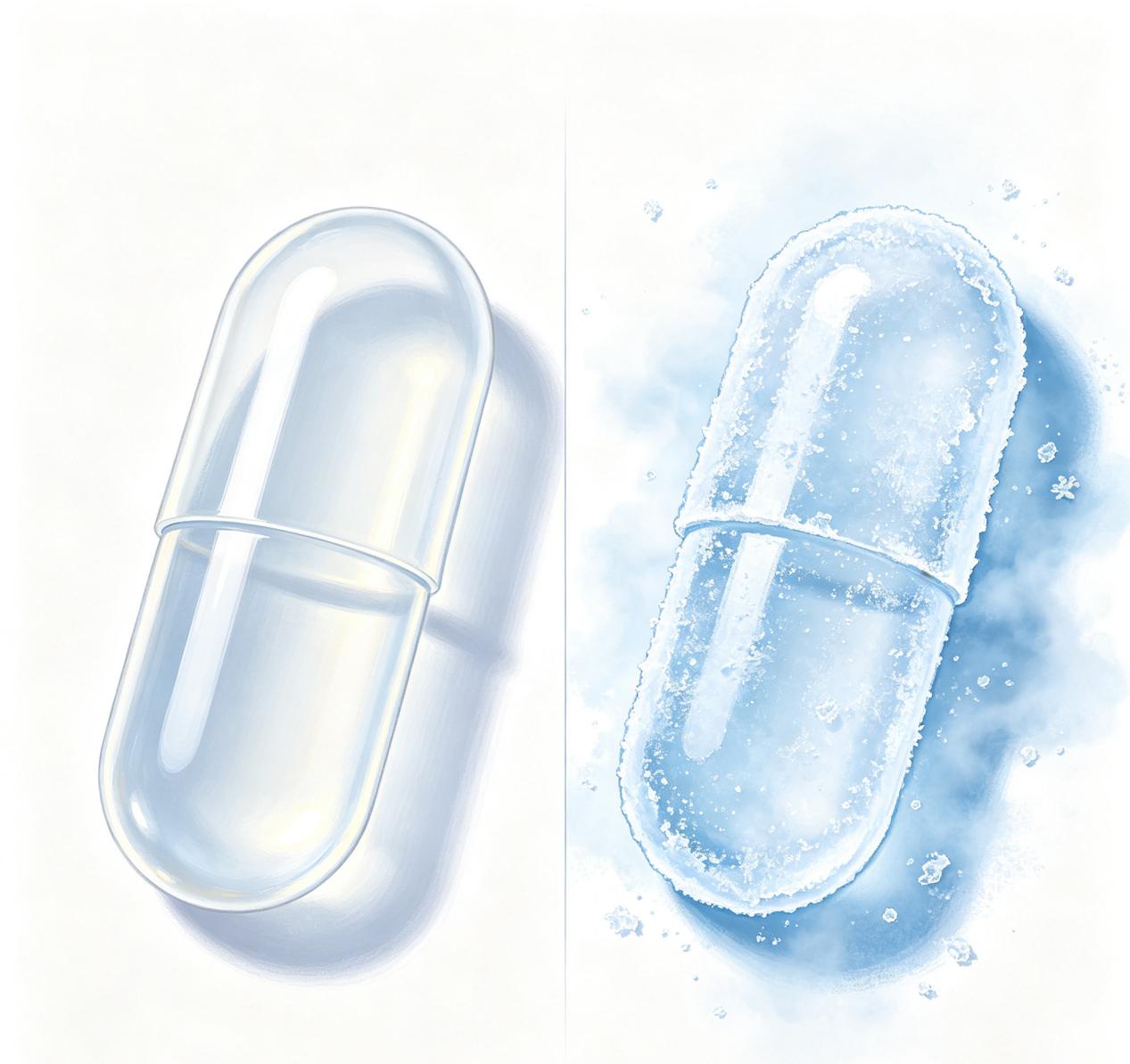
Will Gelatin Capsules Become Hard at Low Temperatures?
The primary component of gelatin empty capsules is pharmaceutical-grade gelatin, a high-molecular-weight substance extracted from animal collagen. The unique properties of gelatin dictate that it is highly sensitive to environmental temperature and humidity.
In low-temperature environments (typically below 15°C/59°F), the mobility of the gelatin molecular chains weakens, and the microscopic distribution of moisture within the capsule shell changes. This alters the physical properties of the capsule wall, manifesting as hardening, brittleness, and a loss of original elasticity. When subjected to squeezing or shearing forces in this state, capsules are highly prone to cracking, splitting at the seams, or leaking powder. This not only affects the product's appearance but can also lead to inaccurate dosing.
Storage Precautions for Empty Gelatin Capsules
To maintain the optimal quality of empty gelatin capsules and prevent them from hardening in the cold or degrading from moisture, the following strict storage precautions must be observed:
1. Strictly Control Environmental Temperature
The storage temperature should be maintained between 15°C and 25°C (59°F-77°F). During sudden winter temperature drops, warehouses should implement insulation measures; in summer, cooling measures are required. Never place capsules directly in unheated cold storage or outdoor freezing environments.
2. Maintain Appropriate Relative Humidity
Gelatin is hydrophilic. Excessively high ambient humidity will cause the capsules to absorb moisture, becoming soft, sticky, and deformed. Conversely, humidity that is too low (below 35%) will accelerate moisture loss, making them brittle. It is recommended to control the warehouse's relative humidity between 35% and 65%.
3. Keep Sealed and Away from Light
Empty gelatin capsules should be stored in a cool, dry, and dark environment. Once the original packaging is opened, it should be resealed immediately to prevent prolonged exposure to air, which can lead to moisture loss or absorption.
4. Avoid Heat Sources and Water
The storage location should be kept away from radiators, stoves, direct air conditioning vents, and water sources. Localized high heat or high humidity can cause irreversible damage to the physical and chemical properties of the capsules.
5. Follow the "First-In, First-Out" (FIFO) Principle
In warehouse management, dispatching should strictly follow the manufacturing batch numbers and storage durations to prevent capsules from natural aging due to prolonged storage. The general shelf life is 18 to 24 months; expired capsules must not be used for filling.
Conclusion
Gelatin empty capsules do indeed harden and become brittle at low temperatures, which is a natural phenomenon determined by their material characteristics. As long as the aforementioned storage precautions are strictly followed during transportation and warehousing, and temperature and humidity are well-controlled, capsule damage can be effectively prevented, thereby safeguarding the quality of pharmaceuticals and health supplements, as well as medication safety.


