


The main empty capsule materials are gelatin, HPMC and pullulan. Capsules can also be classified by release behavior, such as standard, enteric or acid-resistant designs, and by filling application, appearance, formulation and size. These categories overlap: an HPMC capsule can be enteric, printed and made to a particular size. Choosing the right shell means matching these properties to your formulation and target market.
This guide focuses on two-piece hard capsule shells for pharmaceutical and supplement development. It also explains liquid-filled hard capsule applications, which require an appropriate shell and sealing process. At KornnacCaps, we help buyers compare these options before requesting specifications and trial samples.
Capsule size and appearance illustration. Not to scale; colors do not identify the shell material or release profile.
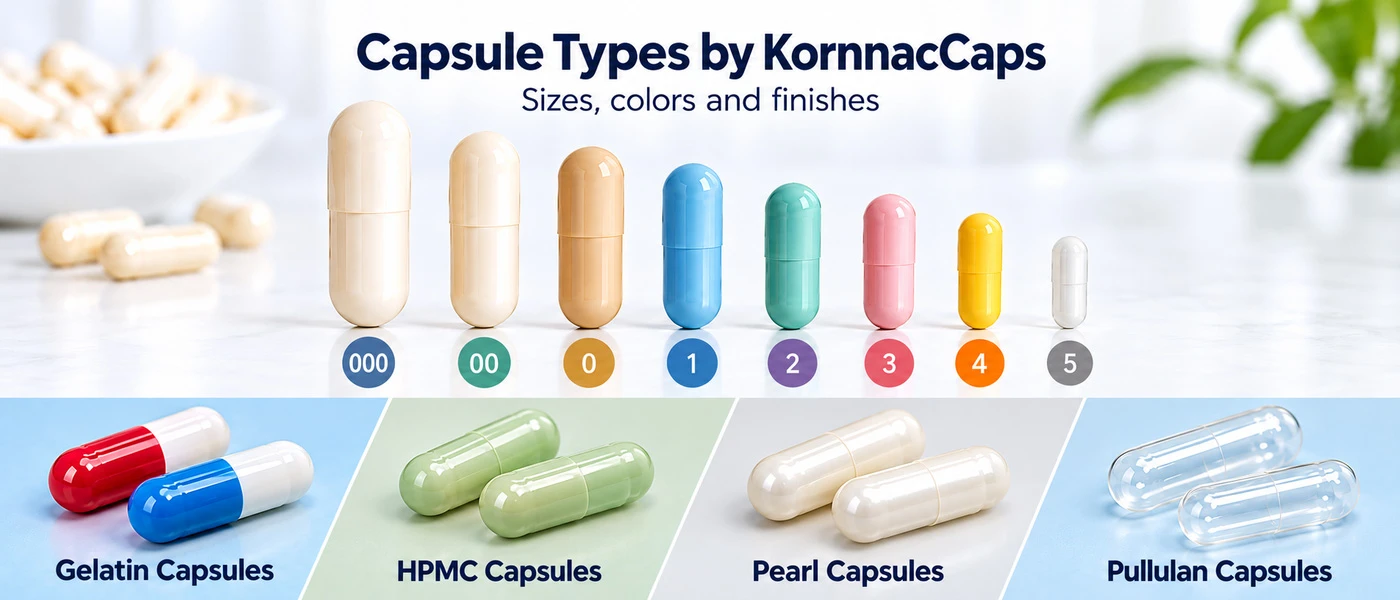
Types of empty capsules by shell material
Gelatin capsules
Gelatin is an animal-derived protein obtained from collagen. It is a well-established shell material for compatible powders and granules. Bovine gelatin is a source option within this category, rather than a separate release technology.
When comparing gelatin capsules, consider the formulation, dietary positioning and storage conditions. Moisture exchange and interactions between the fill and shell can affect performance, so use the agreed product specification and stability evaluation instead of assuming that one moisture range or shelf life applies to every gelatin capsule.
Explore KornnacCaps gelatin capsules
HPMC vegetable capsules
HPMC, also called hypromellose, is a cellulose-derived material used for non-animal capsule shells. It is a useful option when a project requires plant-based positioning or when a lower-moisture shell is being evaluated for a moisture-sensitive fill.
Lower shell moisture does not make a capsule moisture-proof. Confirm the full composition, relevant vegetarian or vegan statement, and compatibility with your fill. Standard HPMC capsules are not automatically enteric or acid-resistant.
Explore KornnacCaps HPMC capsules
Pullulan capsules
Pullulan is a polysaccharide produced by fermentation. Pullulan shells provide another non-animal option for brands comparing capsule materials. Finished shells can contain additional ingredients, so review the composition rather than assuming that every pullulan capsule contains only pullulan and water.
For an oxygen-sensitive formulation, request relevant barrier and stability evidence for the actual shell, packaging and storage conditions. Organic pullulan requires separate certification and supply-chain verification; ordinary pullulan should not be described as organic by default.
Explore KornnacCaps pullulan capsules
Starch-based shells are another industry option, but material availability, specifications and manufacturing compatibility should be confirmed with the supplier.
Types of empty capsules by release behavior
Standard capsules
Standard gelatin and HPMC capsules are used when gastric resistance is not required. Shell opening, dissolution of the contents and absorption are separate processes. A laboratory disintegration result should not be presented as a guaranteed release time in the human stomach or as proof of faster absorption.
Enteric gelatin and enteric HPMC capsules
Enteric designs are intended to resist an acidic stage and open under specified intestinal test conditions. The base material can be gelatin or HPMC, so buyers can evaluate release requirements alongside animal-source or plant-based preferences.
Request the acid-stage and subsequent buffer-stage specifications, including the medium, temperature and acceptance criteria. Confirm performance with the filled formulation. An enteric shell alone does not demonstrate a particular clinical outcome, complete protection of every ingredient, or delivery to the colon.
Explore KornnacCaps enteric capsule options
Acid resistant HPMC capsules
Acid-resistant HPMC is a separate option to evaluate when delayed opening in acidic conditions is desired. The name does not establish equivalence to a particular enteric specification. KornnacCaps documentation treats acid-resistant and enteric products separately, with different test requirements.
Compare the actual test methods and acceptance limits before substituting one for the other. Acid resistance also does not establish sustained release over several hours; that requires evidence for the complete dosage form.
Special formulations and appearance options
Titanium dioxide free capsules
TiO2-free capsules exclude titanium dioxide from the specified formulation. They can be considered where a brand or destination market requires its omission. White or opaque capsules are not necessarily made with titanium dioxide; the composition must be checked, including printing ink when used.
In the European Union, authorization of titanium dioxide as a food additive was withdrawn. Medicines are addressed separately, and the European Commission has confirmed continued allowance in medicines. A TiO2-free shell alone does not establish compliance of the whole product in every market.
Source: European Commission - Withdrawal of E171 food additive authorization
Source: European Commission - Titanium dioxide in medicinal products
Explore KornnacCaps TiO2-free capsule options
SLS free capsules
SLS-free identifies a formulation without sodium lauryl sulfate. It can be part of a customer specification, but it does not by itself establish that the finished product is safer, non-irritating or free from all other additives. Confirm the declaration for the exact capsule supplied.
Explore KornnacCaps SLS-free capsules
Pearl capsules and branded appearance
Pearl capsules offer a pearlescent appearance for visual differentiation. Color combinations and logo printing can also support product identification. These are appearance choices, not independent evidence of taste masking, greater bioavailability or a different release profile.
Transparent translucent and opaque shells
Transparency describes how much the shell allows the contents to be seen. The cap and body can have different appearances; a transparent body with an opaque cap is a combination, not a universal definition of a translucent shell. For light-sensitive ingredients, evaluate the actual shell and packaging together rather than relying on color alone.
Capsule sizes capacity and theoretical fill weight
Common size labels run from 000 through 00, 0, 1, 2, 3, 4 and 5, with larger numbers generally indicating smaller capsules. Elongated variants such as 00EL and 0EL provide additional options. Availability and dimensions depend on the material and product series.
The table below uses selected KornnacCaps gelatin capsule specifications. Locked length includes a tolerance of ±0.3 mm in the source specification. Estimated powder fill is calculated at two example bulk densities; it is not the empty shell weight or a guaranteed production fill weight.
|
Size |
Volume |
Locked length |
Fill at 600 |
Fill at 800 |
|
00EL |
1.02 |
25.3 ±0.3 |
612 mg |
816 mg |
|
00 |
0.91 |
23.3 ±0.3 |
546 mg |
728 mg |
|
0EL |
0.78 |
23.5 ±0.3 |
468 mg |
624 mg |
|
0 |
0.68 |
21.7 ±0.3 |
408 mg |
544 mg |
|
1 |
0.50 |
19.4 ±0.3 |
300 mg |
400 mg |
|
2 |
0.37 |
18.0 ±0.3 |
222 mg |
296 mg |
|
3 |
0.30 |
15.9 ±0.3 |
180 mg |
240 mg |
|
4 |
0.21 |
14.3 ±0.3 |
126 mg |
168 mg |
Source: KornnacCaps, Specification and Size Table of Vacant Gelatin Capsules, version 250617. Request the current specification through the contact link below. These values should not be transferred automatically to HPMC, pullulan or enteric products.
Theoretical fill weight in mg = capsule volume in mL multiplied by powder bulk density in mg/mL.
For example, a size 0 capsule with a reference volume of 0.68 mL gives an estimate of 408 mg at 600 mg/mL, or 544 mg at 800 mg/mL. Actual filling depends on powder flow, compaction, usable volume and equipment settings. Confirm the result by trial filling; request separate specifications for 000, 5 and other variants.
Request the current size chart and capsule samples for filling trials.
How to choose an empty capsule for your project
Start with the formulation requirement, then compare material and function. Use this matrix to shortlist options for testing, rather than treating it as a final formulation approval.
|
Project requirement |
Options to evaluate |
What to confirm |
|
Compatible powders or granules |
Standard gelatin or HPMC |
Shell interaction, filling performance and storage |
|
Plant-based positioning |
HPMC or pullulan |
Composition and product-specific vegan or vegetarian documentation |
|
Moisture-sensitive fill |
Lower-moisture shell options such as HPMC |
Moisture exchange and finished product stability |
|
Gastric resistance |
Enteric gelatin or enteric HPMC; assess acid-resistant products separately |
Acid-stage and buffer-stage tests with the formulation |
|
Compatible liquid fill |
Liquid-filled hard capsule system |
Shell compatibility, seal integrity and stability |
|
Special appearance or ingredient exclusions |
Pearl, printed, TiO2-free or SLS-free options |
Exact composition, ink and destination requirements |
Check sourcing and quality documents
Bovine origin, vegetarian suitability, Halal certification and Kosher certification answer different questions. For a Halal project, request the applicable certificate, including BPJPH documentation where relevant, and verify the holder and product scope. Do not assume a bovine capsule is automatically Halal or that a raw material certificate covers the finished shell.
Request a current technical data sheet, relevant composition statements and a batch-specific Certificate of Analysis. Where required, ask for product-specific information on non-GMO status, TSE/BSE, preservatives and the absence of ethylene oxide treatment. A statement that ethylene oxide is not used is not an absolute zero-residue test result or a claim that the capsule is sterile.
Regulatory filings and manufacturing standards should be described accurately. An FDA Drug Master File is a confidential submission, not FDA approval or a product certification. Similarly, a GMP compliance statement should not be relabeled as a regulator-issued certificate.
Source: U.S. FDA - Drug Master Files
https://www.fda.gov/drugs/forms-submission-requirements/drug-master-files-dmfs
Frequently asked questions
Which is better gelatin or HPMC ?
Neither is universally better. Gelatin is a well-established option for compatible formulations. HPMC is useful when non-animal sourcing or lower shell moisture is a priority. Compare formulation compatibility, filling results, target-market requirements and cost.
Are all vegetable capsules enteric ?
No. Vegetable describes material origin or positioning, not gastric resistance. Standard HPMC and pullulan should be distinguished from specifically designed and tested enteric or acid-resistant products.
Are acid resistant capsules the same as enteric capsules ?
Not necessarily. Compare the specified acid exposure, test medium and subsequent release criteria. A product name alone is not sufficient to establish equivalent performance.
Can any empty hard capsule hold liquids ?
No. Liquid filling requires a compatible shell, suitable formulation and validated sealing process. Oils or liquid actives are candidates for assessment, not automatic approval for use in an ordinary powder capsule.
Are bovine gelatin capsules automatically Halal ?
No. Bovine identifies the animal source. Halal suitability requires the applicable certification and verification of its product and manufacturing scope.
How do I calculate the capsule size for my powder ?
Estimate the required volume by dividing the intended fill weight by powder bulk density, using consistent units. Compare that volume with the capsule specification and verify the selection in filling trials.
Does TiO2 free mean transparent ?
No. TiO2-free describes an ingredient exclusion, while transparent describes appearance. Check the formulation and any alternative opacifying ingredients for the proposed product and destination market.
Discuss your capsule requirements with KornnacCaps
KornnacCaps offers gelatin and vegetable capsule options alongside liquid-filled applications and appearance customization. Share your fill type, intended dose, preferred material, release requirement, target market and estimated order quantity so that the relevant products and supporting documents can be discussed.
The most useful next step is to compare current specifications and evaluate samples with your formulation and equipment. This turns a general capsule category into a practical purchasing decision.
Contact KornnacCaps to request suitable capsule samples and a quotation.
References and technical sources
Public sources explain the regulatory distinctions discussed above. Company specifications apply only to the named product and version; request current documents before procurement.
European Commission - Withdrawal of E171 food additive authorization
https://food.ec.europa.eu/food-safety/food-improvement-agents/additives/re-evaluation_en
European Commission - Titanium dioxide in medicinal products
https://health.ec.europa.eu/publications/commission-staff-working-document-use-titanium-dioxide-medicinal-products_en
U.S. FDA - Drug Master Files
https://www.fda.gov/drugs/forms-submission-requirements/drug-master-files-dmfs
KornnacCaps - Specification and Size Table of Vacant Gelatin Capsules, version 250617. Company technical document; request a current copy from
https://www.kornnaccaps.com/contact-us


