


Empty vegetable capsules are commonly made from hydroxypropyl methylcellulose (HPMC, also called hypromellose) or pullulan. Starch and modified starch are also used in some capsule formulations. These materials provide alternatives to animal-derived gelatin, but they differ in moisture behavior, oxygen protection and formulation requirements.
For pharmaceutical and supplement manufacturers, choosing a capsule shell means matching the material to the ingredients, intended release profile and target market. This guide explains the main materials, supporting excipients and practical checks to make before selecting a supplier.
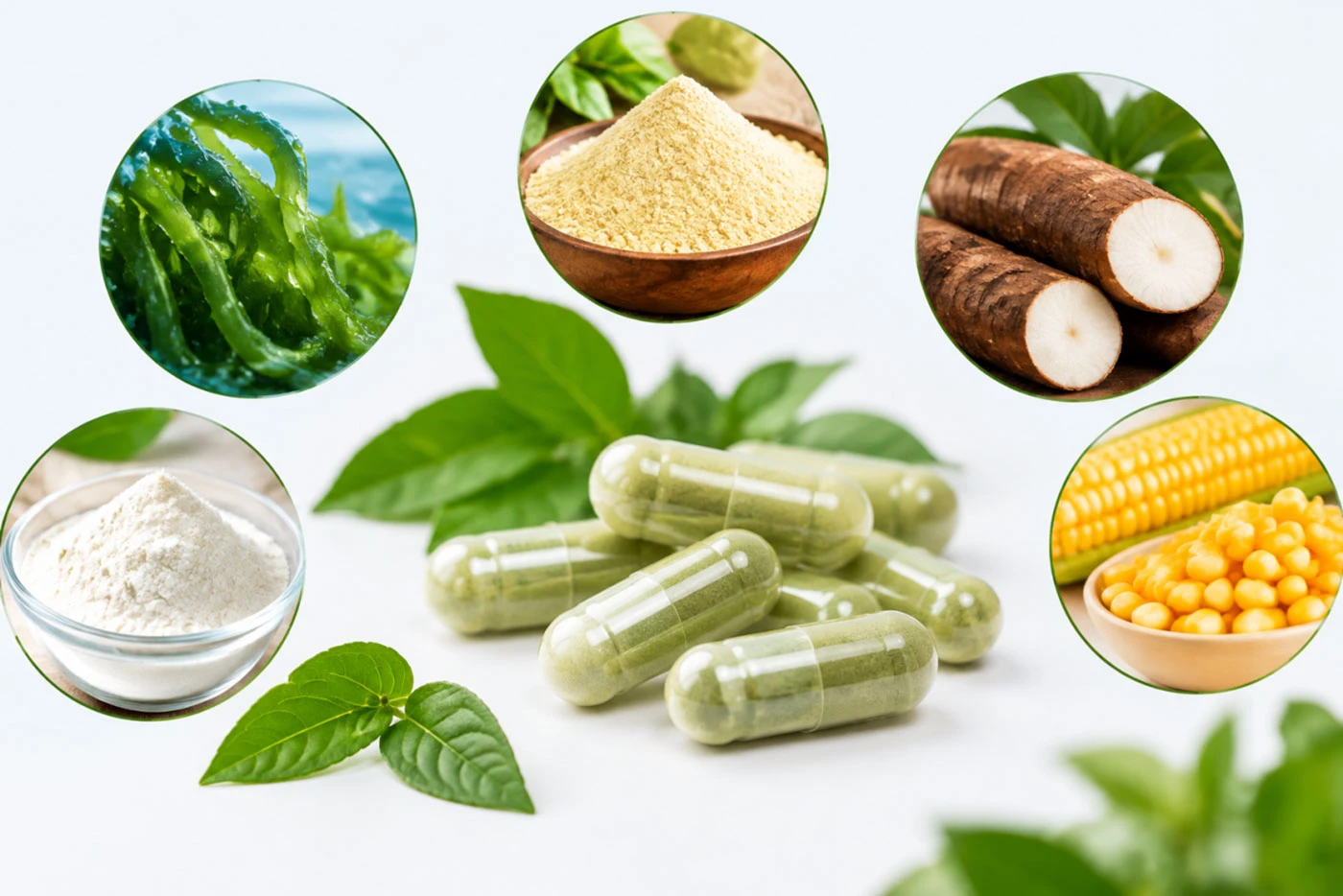
Common Materials Used in Empty Vegetable Capsules
HPMC capsules made from plant cellulose
HPMC is a chemically modified cellulose polymer used to form non-animal capsule shells. It is derived from cellulose rather than gelatin; it should not be confused with unprocessed plant fiber. The FAO/WHO Joint Expert Committee on Food Additives defines HPMC as methyl cellulose modified with hydroxypropyl groups attached through ether links.
Source : FAO/WHO JECFA, Hydroxypropylmethyl Cellulose specification, 2004
Lower shell moisture can make HPMC useful for moisture-sensitive or hygroscopic fills. As a published product-specific example, Qualicaps reports a moisture content of 4.0–6.0% for its Quali-V HPMC capsules, compared with 13–16% for gelatin capsules. These figures describe that manufacturer's reference products, not a universal HPMC specification or a KornnacCaps test result. Always check the selected grade's specification and certificate of analysis.
Source : Qualicaps, Quali-V pharmaceutical capsule technical information
HPMC is also worth evaluating when a formulation is incompatible with gelatin. However, material selection does not replace compatibility and stability testing. A clear HPMC shell does not automatically protect light-sensitive ingredients, and no capsule should be treated as unaffected by heat or humidity.
Considering HPMC for your formulation? Contact KornnacCaps to discuss capsule specifications and your filling requirements.
Pullulan capsules made through fermentation
Pullulan is a polysaccharide produced by microbial fermentation of a starch-derived feedstock. JECFA describes production from food-grade hydrolysed starch using a non-toxin-producing strain of Aureobasidium pullulans. Although commonly grouped with vegetable capsules, pullulan is fermentation-derived rather than simply extracted from plant tissue.
Pullulan forms transparent films and can provide useful oxygen-barrier properties. Manufacturer documentation for Capsugel Plantcaps identifies oxygen protection as a feature of its pullulan capsules. This supports considering pullulan for oxidation-sensitive formulations, but it does not establish identical performance for every pullulan shell. Confirm protection through testing of the filled capsule and final packaging, particularly for vitamins or probiotics with specific stability requirements.
Starch and modified starch capsule materials
Starch offers another route to non-animal capsule shells. Its performance depends on the starch source, modification method and other ingredients used in the formulation. Research on arrowroot starch blended with sodium alginate illustrates how polymer combinations and plasticizers can be used to address shell formation and brittleness. Such formulation research should not be interpreted as proof that all starch capsules have equivalent commercial performance.
For buyers, the important questions are whether a specific starch-based capsule can withstand handling, run reliably on the filling line and meet the required disintegration and storage specifications. Compare total production cost and validated performance rather than assuming that a low-cost raw material always produces a lower-cost finished capsule.
Other Ingredients in Vegetable Capsule Shells
The main polymer is not necessarily the complete ingredient list. Depending on the capsule formulation, gelling agents, plasticizers, colorants or processing aids may also be used. Glycerol, for example, is used as a plasticizer in the starch-based research described above. Buyers should request the complete shell composition and the origin of relevant ingredients rather than assume that every vegetable capsule has the same formula.
Colorants and opacifiers require a market-specific review. Titanium dioxide should not be presented as a universally acceptable choice: the European Commission states that it is no longer permitted as a food additive in the EU. Pharmaceutical requirements must be assessed separately. Confirm the intended product category and destination market before approving any colored or opaque shell.
Source : European Commission, Food additive re-evaluation and titanium dioxide
Benefits and Limits of Vegetable Capsules
Vegetable capsules offer a non-gelatin option for products intended for vegetarian or vegan consumers. However, the shell material alone does not establish the status of the complete supplement or medicine. Review the fill ingredients, processing aids and supporting declarations; verify any halal or kosher certification for the specific product rather than assuming it from the material name.
Material properties can support formulation stability, but they do not justify blanket claims of superior safety, zero allergy risk or resistance to all storage conditions. Likewise, preservative-free production, sterilization practices and environmental benefits should be supported by supplier documentation. Plant origin by itself is not evidence of a lower environmental footprint.
Vegetable capsules are not automatically enteric capsules
"Vegetable" describes the origin or type of shell material, while "enteric" describes a release function. Standard HPMC or pullulan capsules should not be assumed to resist stomach acid. Enteric performance requires a specifically designed shell or coating and appropriate testing. For example, published manufacturer information describes an HPMC and HPMC acetate succinate bilayer designed for acid resistance; this is a specific technology, not a property shared by all HPMC capsules.
Need to distinguish a standard vegetable shell from an enteric option? Share your intended release requirements with KornnacCaps before selecting a capsule.
How to Choose a Vegetable Capsule Supplier
Start with your formulation. Consider HPMC when shell moisture or compatibility with gelatin is a concern; evaluate pullulan when oxygen protection is important; and assess starch-based options against their demonstrated mechanical and release performance. Confirm the decision with filled-product testing, not the material name alone.
Ask prospective suppliers for the documents and samples needed to assess the following:
• Complete shell composition, raw-material traceability and declarations supporting dietary claims.
• A product specification and batch certificate of analysis covering relevant quality attributes.
• Evidence of compliance with applicable pharmacopoeial requirements and target-market rules for the intended use.
• Disintegration or dissolution data, recommended storage conditions and compatibility information.
• Capsule dimensions, available sizes and colors, and samples for trials on your filling equipment.
KornnacCaps manufactures vegetable capsules and offers options in capsule size and color. Discuss the available material grades and documentation for your project so that the selected capsule fits both the formulation and the intended market.
Frequently Asked Questions
Are vegetable capsules made from vegetables?
The term usually refers to non-animal capsule materials rather than whole vegetables. HPMC is cellulose-derived, while pullulan is produced through fermentation of a starch-derived feedstock, as described in the material sections above.
Are HPMC and pullulan the same material?
No. HPMC is a cellulose derivative; pullulan is a fermentation-derived polysaccharide. Compare their specific grades against the moisture, oxygen and handling requirements of your formulation rather than treating them as interchangeable.
Which material is best for empty vegetable capsules?
There is no single best material for every formulation. Choose according to ingredient compatibility, required protection, release behavior, filling performance and documented compliance. Packaging and storage conditions are part of that decision.
Choosing the Right Material for Your Product?
HPMC, pullulan and starch-based materials offer different approaches to non-animal capsule shells. Understanding those differences helps manufacturers select a capsule on the basis of evidence, rather than broad claims about plant-based products. The most useful comparison is the performance of the actual capsule grade with your formulation.
Contact KornnacCaps to discuss your vegetable capsule requirements and request available specifications and samples for evaluation.
References
[1] FAO/WHO JECFA, Hydroxypropylmethyl Cellulose specification, 2004.
[2] Qualicaps, Quali-V pharmaceutical capsule technical information.
[3] FAO/WHO JECFA, Pullulan specification in Food and Nutrition Paper 52 Addendum 13, 2005.
[4] Capsugel, Plantcaps pullulan capsule product information.
[5] Journal of Advanced Pharmaceutical Technology and Research, 2025, Simplex lattice design for the development of arrowroot starch and sodium alginate with calcium chloride crosslinker as a capsule shell alternative.
[6] European Commission, Food additive re-evaluation and titanium dioxide.
[7] Capsugel, Enprotect FAQ on pH based dissolution.


