

Pullulan and HPMC are two animal-free capsule shell options, but they solve different formulation problems. Pullulan is worth evaluating when oxygen protection and a transparent presentation are priorities. HPMC is a practical starting point for many dry-powder products, particularly when shell moisture and production economics matter. The final choice should be based on the exact capsule grade, filled-product testing and packaging, not the material name alone.
For supplement brands and contract manufacturers, this guide compares origin, oxygen protection, moisture behavior, release, appearance and cost, then turns those differences into a purchasing checklist.
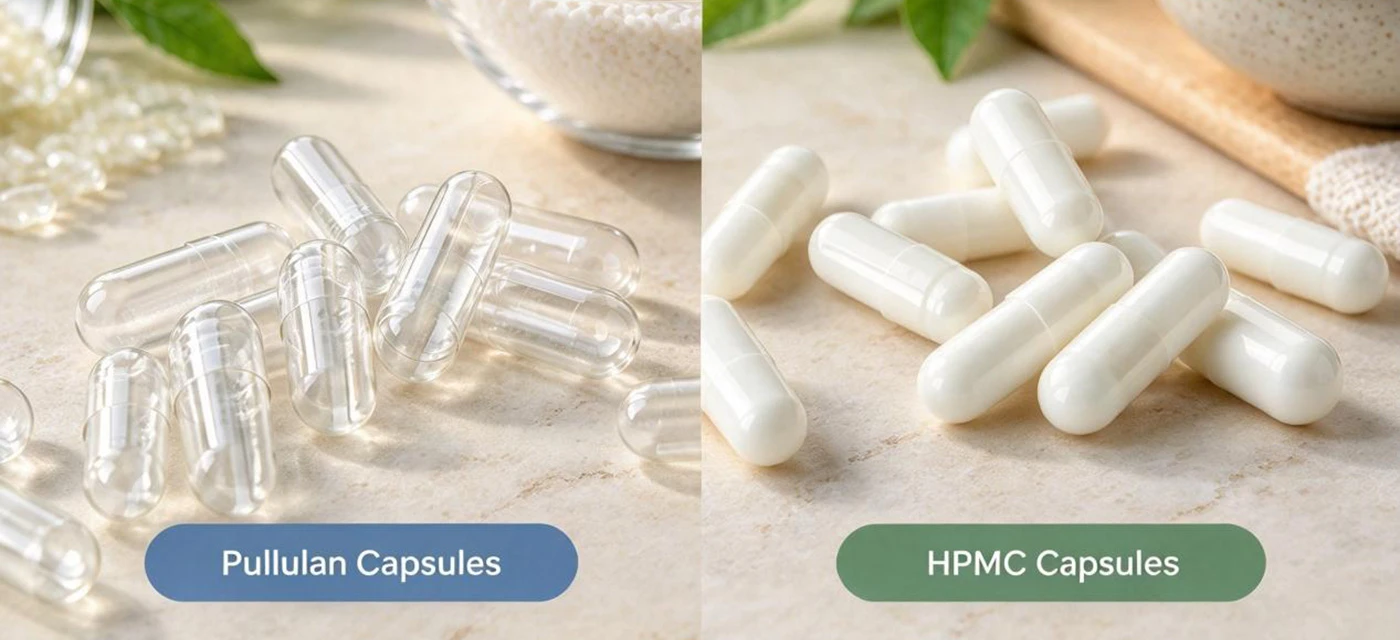
Pullulan and HPMC at a glance
|
Selection factor |
Pullulan capsules |
HPMC capsules |
|
Polymer origin |
Fermentation-derived polysaccharide |
Chemically modified plant cellulose |
|
Main reason to evaluate |
Oxygen-sensitive formulations and transparent presentation |
Low-moisture shell options and broad dry-fill applications |
|
Oxygen protection |
Strong barrier potential; verify the specific shell |
Evaluate grade-specific barrier data and packaging |
|
Moisture behavior |
Follow supplier limits and test the filled product |
Low shell moisture can help; moisture exchange still occurs |
|
Release |
Standard grades can provide immediate release |
Standard grades can provide immediate release; formulation matters |
|
KornnacCaps appearance |
Transparent options |
Ask about transparent and colored options |
|
Commercial fit |
Compare the quoted premium with a demonstrated product benefit |
Assess price, filling yield and supply terms |
These are selection considerations, not interchangeable specifications. Compare samples under the same test and storage conditions.
Explore KornnacCaps vegetable capsule options
What the two capsule materials are made from
Pullulan capsules
Pullulan is a film-forming polysaccharide produced by microbial fermentation of carbohydrate feedstocks. Its fermentation origin is useful for explaining the material to customers, but the finished shell still needs an ingredient declaration. Do not assume that every pullulan capsule is additive-free, certified organic or covered by the same vegan certification.
HPMC capsules
HPMC stands for hydroxypropyl methylcellulose, also called hypromellose. It is made by chemically modifying cellulose derived from plant sources. This processing does not make the shell animal-derived. Depending on the manufacturing system, an HPMC capsule may contain additional gelling ingredients; request the full composition rather than judging it by the polymer name.
Oxygen protection and product stability
Pullulan is a useful candidate when oxidation is a major formulation risk. Capsugel describes its pullulan-based Plantcaps as an option for oxygen protection. This supports evaluating the material, but it does not establish a universal performance ratio or prove that every pullulan shell outperforms every HPMC shell under all conditions.
Source: Capsugel Plantcaps technical overview
A two-piece capsule is not a hermetically sealed package. The cap-body joint, oxygen in the fill and bottle headspace, external packaging and storage conditions all influence stability. Ask for comparative data that state temperature, relative humidity and the test method. Confirm the result with your actual formulation in its intended bottle or blister.
For an oxygen-sensitive probiotic or antioxidant blend, screen pullulan alongside a suitable HPMC grade. For probiotics, include moisture control, strain-specific viability and the required release site in the study. For oils such as omega-3 formulations, separately validate shell compatibility, liquid-filling equipment and sealing; oxygen barrier alone is not enough to establish suitability.
Moisture content and humidity control
Low shell moisture can make HPMC attractive for moisture-sensitive or hygroscopic fills. As a product-specific example, Capsugel reports 6–7% water content for its Vcaps Plus capsules. This is not a specification for all HPMC capsules or for KornnacCaps products; obtain the current specification for the grade you are buying.
Low moisture does not mean zero moisture transfer. Water can redistribute between the shell, fill and surrounding air. Evaluate both shell water content and the filled product's moisture behavior, including water activity where relevant. Check for brittleness, softening, clumping and changes in active content during storage.
For either material, use the supplier's handling limits and assess the final packaging. A desiccant may help some formulations, but excessive drying can also affect shell performance. Do not assume pullulan always needs stricter controls than every HPMC grade without comparing their actual specifications.
Request capsule specifications and samples for your formulation
Appearance and release performance
Transparency and brand presentation
KornnacCaps offers transparent pullulan capsules. For HPMC, discuss the available transparent and colored options for your chosen size and target market. Compare real samples for clarity, gloss and printing requirements. Appearance alone cannot identify a shell's material, and a clear shell should not be treated as a light barrier.
Disintegration is not the same as absorption
Both materials can be used for immediate-release capsules. There is no single dissolution time that applies to every HPMC shell, and pullulan should not be described as automatically producing faster absorption. Shell opening, ingredient dissolution and absorption are different events.
A comparative study of HPMC capsule formulations found that rupture and dissolution behavior depended on the shell system and testing conditions. Request results for the specific filled product and method, rather than relying on an unsupported blanket claim such as "HPMC takes 15–20 minutes."
Research source: Comparative study of HPMC capsule dissolution
Standard pullulan and standard HPMC capsules are not automatically enteric capsules. If intestinal release is required, specify and validate a dedicated enteric formulation or delivery system. Material selection by itself does not establish gastric resistance.
Cost and supply considerations
Pullulan is often positioned as a premium option, while HPMC is commonly considered for cost-sensitive projects. Treat this as a starting point for quotations, not a fixed price rule. Compare equivalent sizes, order volumes, colors, printing, documentation, shipping terms and lead times.
Calculate cost per acceptable filled capsule, not just price per empty shell. Filling rejects, packaging needs, storage requirements and supplier consistency can change the overall economics. A higher-priced shell is justified only when it delivers a relevant benefit for your product or brand.
How to choose for your formulation
When to evaluate pullulan first
Start with pullulan when oxidation is a demonstrated failure mode and you want to assess a transparent, fermentation-derived shell. Test whether it improves stability enough to support the additional cost. Do not promise a longer shelf life until the finished product data support it.
When to evaluate HPMC first
Start with a suitable HPMC grade for a conventional dry-powder supplement, particularly when low shell moisture, color choices or cost control are important. For hygroscopic ingredients, verify both filling performance and stability rather than relying solely on a moisture percentage.
What to confirm before a bulk order
Define the main risk: oxygen, moisture, light, acid exposure or physical incompatibility.
Request the complete shell composition, grade-specific specification, certificate of analysis and relevant certification scope.
Confirm the target dose, powder density, capsule size, color requirements and intended market.
Run filling trials on your equipment; check separation, locking, leakage where relevant and reject rates.
Test the filled formulation in its proposed packaging under relevant storage conditions, including disintegration or dissolution and stability endpoints.
Compare quotations, minimum order quantities, lead times and change-control arrangements before approval.
Frequently asked questions
Are pullulan and HPMC capsules vegan
Both polymers can be used in animal-free shells. A vegan claim for the finished capsule should be supported by its complete formulation and the supplier's documentation. Certification is product-specific, not automatic.
Which capsule is better for probiotics
There is no universal winner. Pullulan may be worth screening for oxygen protection, while a low-moisture HPMC grade may suit moisture-sensitive strains. Compare viable counts through shelf life in the intended packaging and assess release requirements separately.
Does HPMC always dissolve more slowly
No. Shell composition, test medium and the fill can affect performance. Compare the specific capsule grades using a relevant method; do not infer absorption speed from the shell material.
Are pullulan capsules always transparent
KornnacCaps offers transparent pullulan capsules. This describes our current offering rather than a universal limitation of the polymer. Confirm available sizes and specifications when requesting samples.
Can either material replace an enteric capsule
Not without a validated enteric design. A standard immediate-release shell should not be selected as gastric protection solely because it is made from pullulan or HPMC.
Compare capsule options with KornnacCaps
The right vegetable capsule is the one that performs reliably with your fill and packaging. Share your ingredients, target dose, capsule size, intended market, packaging and expected order volume with KornnacCaps to discuss pullulan and HPMC options. Request samples and current technical documents before moving to a bulk purchase.
Discuss your formulation and request a capsule quotation


