

Empty capsules are one of the most mainstream dosage forms in the pharmaceutical and health supplement industries due to their excellent taste-masking properties, high bioavailability, and portability. However, during the high-speed automated filling process, empty capsules can occasionally rupture, deform, or suffer from defective cuts due to equipment parameters, material characteristics, and environmental factors. This not only leads to powder leakage and increased frequency of equipment downtime for cleaning but also seriously impacts product yield. To prevent empty capsules from cracking during filling, it is necessary to focus on three key areas: material control, equipment debugging, and environmental management.
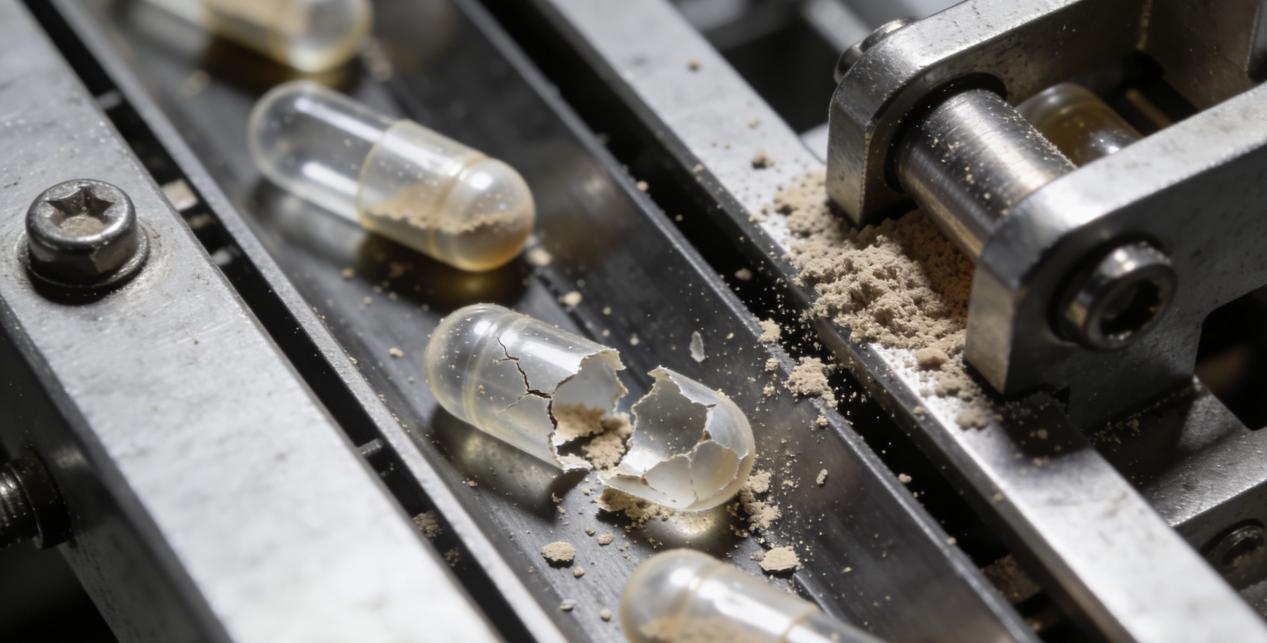
Firstly, strictly controlling the moisture balance between the filling material and the capsules is crucial. The primary component of empty capsules is gelatin and possesses both hygroscopic and dewatering properties. If the powder or granules being filled have a moisture content that is too low (excessively dry), the moisture in the capsule shell will be rapidly absorbed by the material, causing the shell to become brittle and highly prone to cracking during mechanical locking. Conversely, if the material or environmental moisture is too high, the capsule becomes damp and soft, leading to deformation or blockages. Therefore, it is essential to strictly control the moisture content ratio of both the material and the capsules. It is generally recommended to maintain a similar moisture balance between the two; if necessary, appropriate spray humidification treatment can be applied to the capsules.
Secondly, optimizing equipment parameters and ensuring mold compatibility is of paramount importance. The high-speed operation of capsule filling machines exerts significant mechanical stress on the capsules. If there is a mismatch between the size/specification of the mold holes and the capsule model, or if the equipment runs at excessive speeds, the capsules may be subjected to crushing forces during transport, separation, or closure, leading to rupture. Additionally, it is important to regularly check and calibrate the locking force (locking pressure) of the filling machine. Excessive locking force can crush the capsule, while insufficient force may result in loose locks or cap dropping-off. Operators should fine-tune the equipment vacuum and mechanical plunger pressure based on the characteristics of different capsule batches to ensure a Soft Landing and Gentle Locking.
Finally, maintaining a suitable production environment with controlled temperature and humidity acts as a safeguard. Empty capsules are extremely sensitive to their surroundings; low temperatures can make the gelatin brittle, while high humidity can make it soft. It is generally recommended that the temperature in the production workshop be controlled between 20-25°C, with relative humidity maintained between 45%-60%. A stable environment with constant temperature and humidity can minimize fluctuations in the physical properties of the capsules, thereby reducing the risk of breakage.
In summary, preventing empty capsules from cracking during filling requires manufacturers to establish a standardized operating procedure covering material pre-treatment, refined equipment management, and environmental control. Only by paying attention to details and managing scientifically can the breakage rate be effectively reduced, ensuring both production efficiency and high product quality. If there is any questions about empty capsules, Welcome to contact with KornnacCaps.


