

Empty capsules serve as critical carriers for pharmaceuticals and nutraceuticals, and their physical properties are extremely sensitive. Among these, moisture content is a decisive quality indicator. Excessive moisture can cause capsules to become soft, deformed, or even stick together, while insufficient moisture makes them brittle and prone to cracking during transport and storage. Therefore, scientifically and accurately detecting the moisture content of empty capsules is an indispensable part of quality control in pharmaceutical companies.
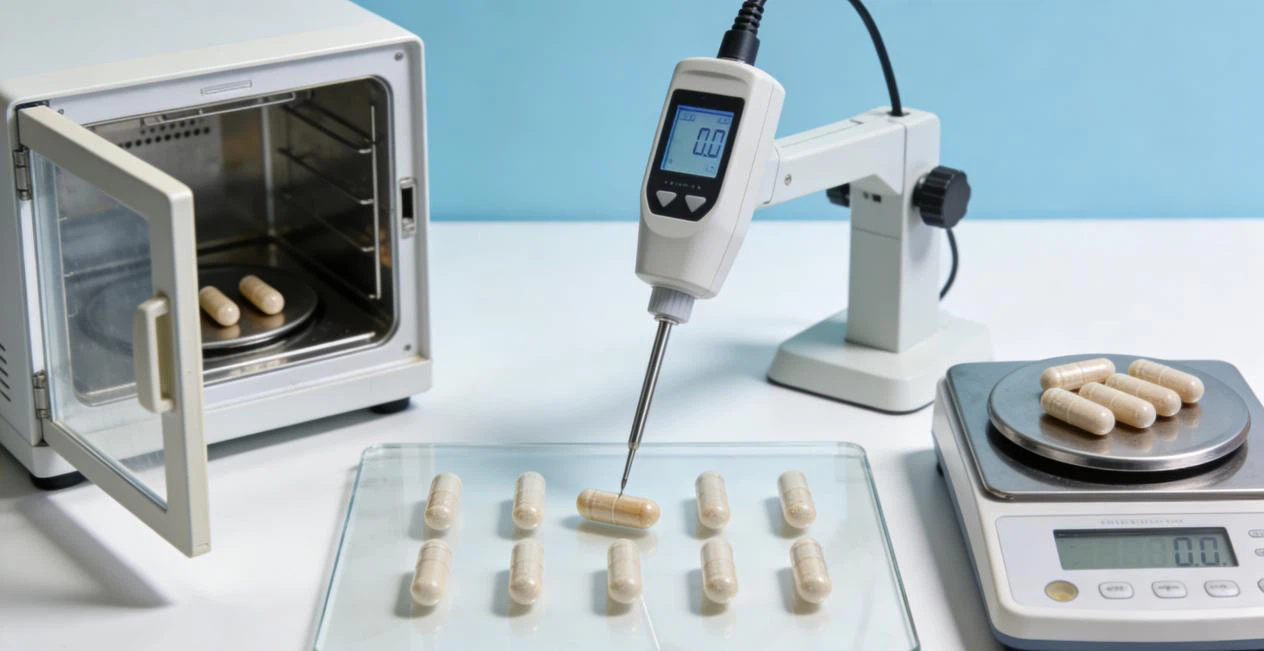
Currently, the detection of moisture content in empty capsules relies primarily on the principle of physical weight change and chemical analysis. In the standard testing prescribed by pharmacopeias, the most commonly used method is the Loss on Drying (LOD) method. This involves heating the sample to evaporate the water, and then calculating the moisture content based on the weight difference before and after drying. For gelatin capsules, strict temperature control during testing is crucial due to their thermal sensitivity; a constant temperature drying oven is typically used. To prevent thermal denaturation of the gelatin, vacuum drying is sometimes employed, allowing moisture to evaporate at lower temperatures under reduced pressure. Although this classic method yields accurate results, it is often time-consuming and struggles to meet the demand for rapid feedback in modern production lines.
To improve testing efficiency, rapid moisture analyzers have found widespread application in the industry in recent years. These instruments typically utilize halogen heating or infrared radiation technology to heat samples directly, significantly shortening the drying time. Their operating principle is also based on weight loss, but they integrate high-precision weighing sensors and intelligent temperature control systems to automatically monitor changes in sample weight and calculate moisture content in real time. Compared to traditional oven methods, this approach eliminates the need for repeated manual weighing and cooling, providing results within minutes, making it ideal for in-process control and rapid screening during production.
Beyond methods based on thermogravimetric principles, Karl Fischer titration is another important detection technique. This chemical method determines moisture content based on the quantitative chemical reaction between iodine and water. For empty capsules that are extremely heat-sensitive or contain volatile components, Karl Fischer titration offers extremely high detection accuracy and can even determine trace amounts of moisture. However, due to its high requirements for reagents and the environment, as well as its relative operational complexity, it is typically used for arbitration analysis or research fields rather than as the primary choice for routine daily production.
Furthermore, with the development of intelligent manufacturing in the pharmaceutical industry, Near-Infrared Spectroscopy (NIR) has also begun to be applied to the online detection of capsule moisture. This non-destructive testing technique predicts moisture content by analyzing the characteristic absorption spectra of samples in the near-infrared light range combined with mathematical models. Its greatest advantages include no sample destruction, no reagents, and extremely fast detection speeds, enabling real-time, continuous monitoring and representing an important direction for the future construction of smart factories.
In summary, there are various methods for detecting the moisture content of empty capsules. In practical applications, enterprises should choose the appropriate detection method based on their specific process requirements, required detection accuracy, and production pace. Whether using the traditional oven method or modern rapid analyzers, ensuring the accuracy and stability of detection data is ultimately aimed at guaranteeing the quality of empty capsules, thereby ensuring the safety and efficacy of the medicinal products. If there is any demands on empty capsules, Welcome to contact with KornnacCaps.


